
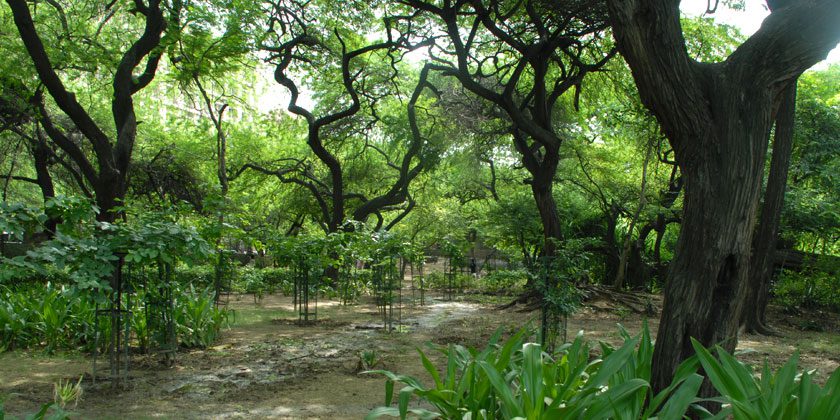
Traffic, Smog, and Concrete — seems like a broad Delhi advertisement. To an extent, it remains true. The remaining picture is in the city’s nooks and corners with its forests, biodiversity parks, ridges, and wetlands which are in its precarious state.
Consider it as Nature’s Luxury, Nature Walks are a way to be acquainted with life around in its stillness and solidarity. We have compiled a list of places you can go for free.

List of Greenzones in Delhi/NCR
1) Lodhi Garden
https://maps.app.goo.gl/PHE2Z4EoxH2rCUGC6

Delhi’s most iconic heritage park, home to 15th- and 16th-century Lodhi and Sayyid-era tombs set among lawns and a lake. A favourite for morning walks, yoga, and picnics, redesigned in its current form in the 1930s and further landscaped in 1968.
2) Nehru Park
https://maps.app.goo.gl/2NdzAtf46ZoHooEMA
An 80-acre park in the Chanakyapuri diplomatic enclave, and named after India’s first Prime Minister, known for open lawns, and fitness tracks.
3) Roshanara Park
https://maps.app.goo.gl/NcWd13N759rgN9zq5
A Mughal-era garden built by Roshanara Begum, daughter of Shah Jahan, located in Shakti Nagar. One of Delhi’s larger gardens, popular for casual sports, with a lake that draws migratory birds in winter and a newer rose garden.
4) Kamla Nehru Ridge
https://maps.app.goo.gl/4x1rwEyjoa8R4D2QA
Also called the Northern Ridge, this is a historic stretch of the Aravalli ridge near Delhi University, notable for its role in the 1857 uprising (the Mutiny Memorial and Flagstaff Tower still stand here). Long degraded by invasive mesquite, it’s since been ecologically restored as a biodiversity park and remains an important groundwater recharge zone.
5) Buddha Jayanti Park
https://maps.app.goo.gl/aMp29SNcXyR5U1eJ8
Set within the Central Ridge forest near Dhaula Kuan, this park was created to mark the 2,500th anniversary of the Buddha’s enlightenment and holds a Bodhi tree sapling brought from Sri Lanka in 1964. Known for its peaceful, meditative atmosphere and a large Buddha statue.
6) Arun Jaitley Park
https://maps.app.goo.gl/TnsJzq6ZpESsjdtRA
A green area near Siri Fort in South Delhi, part of the district’s larger green belt connecting Siri Fort’s forested stretches.
7) Deer Park
https://maps.app.goo.gl/GKJwSAWXE5bE2HKo7
Bordering Hauz Khas, this roughly 60-acre wooded park holds some of Delhi’s oldest monuments, including the Lodhi-era Bagh-e-Alam ka Gumbad. Despite the name, the deers are confined to a fenced 17-acre enclosure rather than roaming freely through the ruins.
8) Jahanpanah City Forest
https://maps.app.goo.gl/7cGRFTDseGgQESRZ8
A dense, 435-acre forest linking Greater Kailash, Chirag Delhi, and Saket — one of South Delhi’s largest green lungs. It was once part of Muhammad bin Tughlaq’s 14th-century city, and today is known for birdwatching, jogging trails, and its relatively hidden, quiet character.
9) Sanjay Van
https://maps.app.goo.gl/4B12Cn79HrhNKsQSA
A roughly 780-acre reserved forest on the Mehrauli ridge, among the wilder and least-manicured of Delhi’s forests. It holds medieval ruins (including parts of Lal Kot) inside dense native tree cover, and is one of the better spots in the city for sightings like nilgai and a wide range of birds.
10) Lado Sarai Forest
https://maps.app.goo.gl/Lr9QieApEZo6r7Z29
Part of the green belt bordering the Mehrauli ridge near Lado Sarai village, adjoining the Qutub Golf Course and Sanjay Van area — less visited than its famous neighbours, with a mix of scrub forest and a few scattered Lodhi-era structures nearby.
11) Mehrauli Archaeological Park
https://maps.app.goo.gl/wqZsMD9yWyo6v9GL8
A roughly 200-acre site beside the Qutub Minar, continuously inhabited for a thousand years and layered with monuments from Rajput, Sultanate, Mughal, and British eras — including Thomas Metcalfe’s 19th-century Dilkusha estate. A rare mix of dense forest cover and open-air history.
12) Aravalli Biodiversity Park, Gurgaon
https://maps.app.goo.gl/HYdPgpQPB9VbNqx3A
A roughly 380-acre restored patch of former mined land near Guru Dronacharya metro station, now home to 300+ native plant species and 185+ recorded bird species. It is one of the clearest examples of what active ecological restoration can achieve in a short span.
Why one must go for a nature walk
When you ask someone in the city to name a tree, be it children or adults, there might be a pretty high chance that they cannot. It’s not their fault due to the way they are surrounded by the concrete and the screens. The city does not make it easier to slow down any day ahead. The noise has become a part of our everyday life.
A nature walk gifts you the familiarity with the natural world. For children, its not just play but building a relationship with the environment. This makes them grow up into empathetic adults, and a childhood spent even partly outdoors, in unstructured exploration rather than scheduled activity, does something for attention, curiosity, and patience that no classroom quite replicates.

Even ten minutes under tree cover or near a water body does more for a frazzled week. The unhurried time spent among trees measurably lowers stress, anxiety, and anger, while improving mood and immunity. You do not need a forest reserve or a hill station for it to work. You need attention, and Delhi has more green cover within a twenty-minute drive of most neighbourhoods than residents tend to realize or use.
Why is it important to be involved with nature
Delhi used to be a city dense with fruit trees with children distantly having memories of climbing them. Due to construction, many things have changed and quietly disappeared over the decade.
While what remains i.e. the ridge forests, the biodiversity parks, the last unbuilt stretches along the Yamuna ends up being treated as background scenery rather than something worth actively defending. The real risk in staying disconnected is that it is hard to fight for a city you have stopped truly seeing. A common myna outside your window, a black kite circling over traffic, a flamingo wading at Okhla — all of it is nature, and all of it is disappearing faster than most residents realize, one small patch at a time. A city only protects what its people notice, and noticing is a habit, not an instinct — it has to be practiced. That is really what a nature walk is for.
Not just the hour spent outdoors, but the attention it rebuilds, one person and one park at a time, before there is nothing left worth walking into.

Coming up: World Wildlife Week
From the beginning of October, we are observing World Wildlife Week. Having its humble beginnings from the 1950s, we are actively involve ourself in fulfilling the purpose of raising awareness about biodiversity conservation, promote the protection of fauna and flora, and educate people on human-wildlife coexistence.
We have a slate of activities coming up to embrace this informative week ahead. More details on how to take part and what’s in store are coming up so stay subscribed to know more!!!