
Have you recently picked up a box with green packaging on it? Think about it. It might be labelled as “eco-friendly”, “all-natural”, “vegan”, or just plain and simple “green”. It may even be surrounded by images of green trees and natural landscapes.
Green has always been associated with nature. The colour that instantly makes us feel safe and connected to our roots. Unfortunately, the colour has been appropriated by capital interests and its meaning distorted. Companies use it to signal that their products are safe, and sustainable, while the truth may be hidden in fine print.
Perhaps one of the most striking examples of this is an item that floods our markets every year during this time: green crackers.
What are green crackers? How are they made?
Let’s start with what green crackers are not. Unlike conventional firecrackers, which use chemical mixtures containing substances such as barium compounds, strontium compounds, aluminium powder, sodium and charcoal to produce colours and explosive effects, green crackers use modified formulations designed to reduce certain emissions, including particulate matter (PM2.5 and PM10). These formulations may replace or reduce the use of certain chemicals, such as barium compounds, and limit aluminium content.
The Council of Scientific and Industrial Research–National Environmental Engineering Research Institute (CSIR-NEERI), which developed these crackers claim that the renewed formulations achieved 30-40 per cent lower particulate matter and gas emissions compared to conventional fireworks.
In simple words, green crackers are not chemical free. Rather than eliminating chemicals, these crackers use modified formulations designed to reduce pollution. The three formulations on the NEERI website are as follows:
- SWAS (Safe Water Releaser): Contains aluminium, sulphur, potassium nitrate and a polymer hydrogel. The hydrogel is intended to help capture some of the particulate matter released when the cracker bursts. The idea is that the material may trap or bind some particles, reducing the amount that escapes into the surrounding air.
- STAR (Safe Thermite): Uses iron oxide to improve combustion efficiency. NEERI says the formulation contains about 40 per cent iron oxide.
- SAFAL (Safe Minimal Aluminium): Uses zeolite-based materials to reduce the amount of aluminium used.
NEERI also reports that certain green cracker formulations reduce particulate emissions. For example, its STAR-F Flower formulation showed reductions of 45.5 per cent in PM10 emissions and 35.6 per cent in PM2.5 emissions compared with conventional fireworks.
Despite this official information, finding a comprehensive list of ingredients and their proportions for green crackers sold in India remains a challenge. For instance, while NEERI states that its STAR formulation contains about 40 per cent iron oxide, the information on its website does not specify the complete composition of the remaining 60 per cent. This makes it difficult for consumers to understand the full chemical makeup of the product from the publicly available information alone.
Is green cracker an oxymoron?
An oxymoron is a figure of speech that brings together two words that appear contradictory, such as “deafening silence”. The phrase “green cracker” might invite the same question, i.e. how can something designed to explode, burn and release smoke be called green? Perhaps “reduced-emission crackers” just isn’t as catchy. Because even though these crackers reduce emissions by 30 per cent, it still does not mean they do not emit any pollution.
It helps to look closer at the chemistry behind the spectacle. The reds, greens, blues and golds of fireworks are not accidental. They are produced by chemical compounds that emit particular colours when heated.
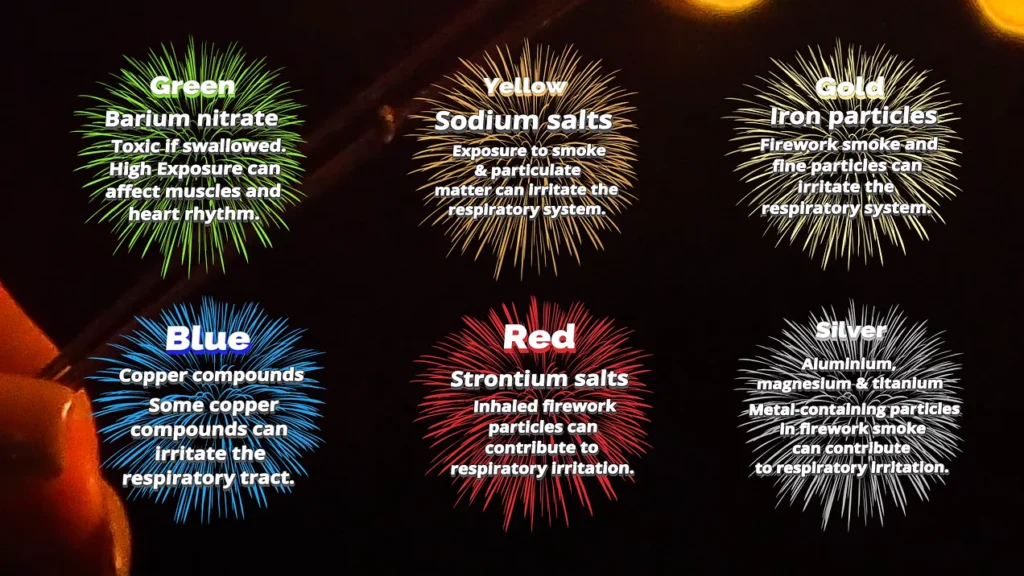
These compounds are just part of the recipe. A cracker also needs fuel and an oxidiser to sustain combustion. Depending on the formulation, ingredients can include charcoal, suplhur and potassium nitrate.
Now, yes green cracker formulations and additives are used to efficiently reduce emissions. But the next time you see red and gold sparkles in the sky, think about what remains in the air and where those residues go.
The smoke is not the only concern
The visible smoke is only part of the problem. Fireworks release PM10 and PM 2.5, which are particles small enough to enter the respiratory system, with the finest particles penetrating deep into the lungs. Exposure can irritate the airways, aggravate asthama and other respiratory conditions, while placing additional strain on your cardiovascular system. Children, older adults and people with existing heart or lung conditions are particularly vulnerable.
Arvind Kumar, Founder, Trustee at Lung Care Foundation and Chest Surgeon at Medanta – The Medicity told NDTV in 2025,
“The word ‘green’ to me is a misnomer which takes away the risk element or rather makes it appear less problematic. A cracker is a cracker. If you burn a cracker, there will be pollution. The best strategy to safeguard yourself is to not burst crackers at all.”
Apart from the invisible particulates suspended in the air, there is another concern. There are residues left behind long after the explosion and the festive excitement have faded. Particles and metals can settle on roads, rooftops, soil, rivers and other surfaces. In 2025, Indian Express reported that soil analysis after firecracker burning confirmed that residual metals do not vanish.
In a 2024 study, researchers examined the residue from six types of conventional firecrackers and six types of green firecrackers. They found that both types left behind potentially harmful chemical elements after burning. Residues from conventional crackers contained aluminium, barium, strontium, magnesium and titanium. Green cracker residues also contained aluminium and barium, along with other chemical compounds. These residues can contaminate the soil and then our food.
Only a few weeks to go before we celebrate the festival of lights (re: not festival of firecrackers), and reports already indicate that fireworks are being sold openly across the Capital, according to Hindustan Times. The article also mentioned that while the major markets were displaying crackers labelled “green crackers”, there were other crackers available on request.
On September 30, 2026, the Supreme Court declined to impose a blanket ban on firecrackers, citing concerns that such a ban could hurt “public sentiments”. It, however, directed the Centre and the expert bodies to assess the impact of barium content in green crackers, on the air quality, until October 15. The matter is likely to be heard on October 29, according to Hindustan Times.
On Wednesday, October 21, just a day after Dussehra celebrations, Delhi’s air quality index (AQI) worsened from 179 at 4pm on October 20 to 245 at the same time on October 21. Widespread firecracker use is seen as one of the most plausible reasons for the worsening AQI.
Can We Find Another Festive Aesthetic?
We may grow attached to something harmful because it reminds us of joy and community. But nostalgia shouldn’t come at the cost of our health.
The scales are already tipped against us when it comes to air quality. So, do we keep debating the right terminology for these crackers, or do we start imagining a different kind of celebration? One that leaves us with memories to cherish, rather than pollutants to breathe. Our lungs might thank us for it.
About the Author
Pooja Das
A writer and researcher, working in the intersection of climate change, media and storytelling.