
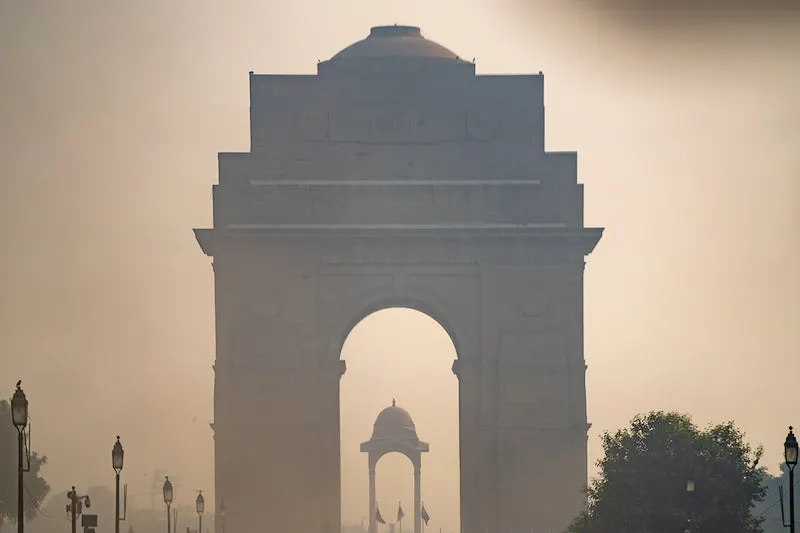
I was 15, and had never been prone to breathing problems, when I developed a bronchitis infection. After weeks of a really bad cold, and probably some ayurvedic remedy I do not remember the name of, the doctor asked me to stay indoors during Diwali. At the time, I didn’t mind, I had always been too sensitive to the sound and the chaos anyway. But a severe asthma attack just two years later made me realise that staying indoors was never really a solution.
Now that the annual winter smog season is around the corner, many like me are finding ways to avoid the worst of it. Just six days into October, and the poor Air Quality Index (AQI) readings had already started making rounds in our daily social media scroll. On October 4, the AQI reached 196, its highest level in more than 82 days, since July 13. The capital’s 2026 monsoon season was also recorded to be the most polluted in seven years, with the average AQI between July and September climbing to 105.
Could El Niño make Delhi’s winter worse?
Unfortunately for us Delhiites, the poor AQI, impending spike in firecracker pollution, stubble burning and winter weather are not our only concerns this year. A potentially strong El Niño, dubbed super El Niño, could worsen pollution levels by contributing to drier winter conditions.
The Print reported that a stronger El Niño during the winter months could lead to a drier season, which would mean more accumulation of pollutants in the atmosphere. We have already seen a 13% monsoon deficit in the whole country which has left parts of the country with depleted water reserves and damaged crops. The Council of Energy, Environment and Water stated that the Pacific sea surface temperatures are expected to be up to 3°C above normal by November 2026, with the possibility of 90% of India facing below-normal rainfall this monsoon.
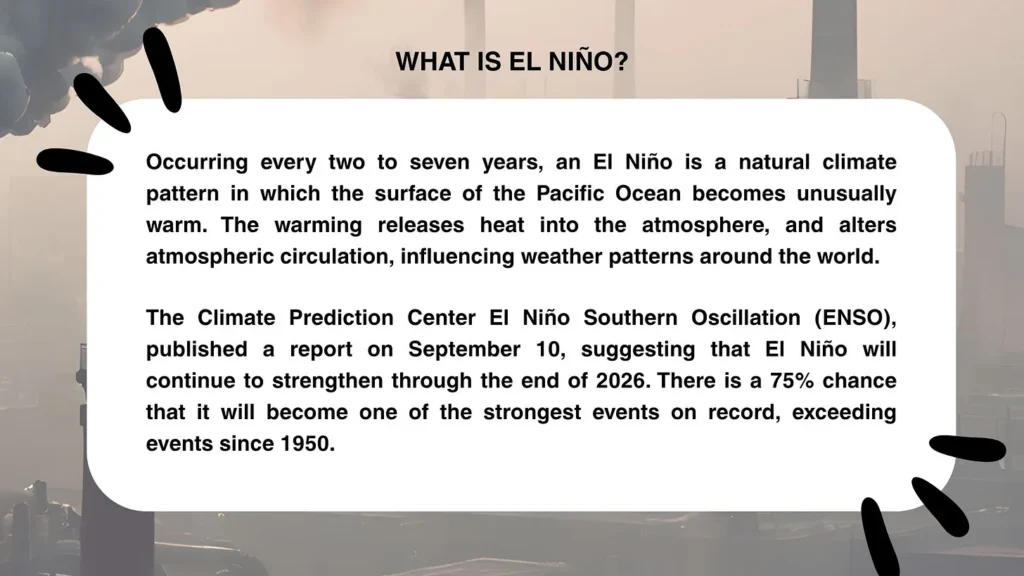
A group of 188 Indian ecologists, conservationists and researchers have have signed an appeal, asking their peers, the government agencies, and even funding bodies to prepare for the upcoming ‘super’ El Niño.
So does this mean we have to prepare ourselves for a monsoon-less winter?
Not necessarily.
El Niño can influence India’s rainfall, but it does not determine the weather on its own. The 1997 El Niño, for instance, did not result in a significantly deficient monsoon across India, partly because atmospheric circulation over the Indian Ocean also played a role in shaping rainfall that year.
On October 12, Delhi woke up to lightning and heavy showers in many parts.
Professor Gufran Beig, Chair Professor at NIAS, IISc, told NDTV, “The Pacific Ocean has warmed by 3.2 degrees Celsius and may touch a record 3.5 degrees Celsius within two months. This means the coming winter will be relatively mild, punctuated by sharp and unpredictable temperature fluctuations. The sudden rainfall witnessed yesterday, despite the withdrawal of the monsoon, offers a glimpse of this unusual weather variability.”
The effects of this unpredictable weather are already being felt elsewhere in north India. In Punjab, unseasonal rainfall has damaged paddy and cotton crops, with the state recording 477 per cent above-normal rainfall in the 24 hours beginning at 8:30 am on October 10, according to The Times of India. The following day, heavy showers flooded grain markets in Fazilka, submerging sacks of harvested paddy in several feet of water. Farmers and commission agents were seen navigating flooded market yards in boats to salvage their produce, as they called for compensation and better drainage and storage facilities, reported Reuters.
Western disturbances can bring rain to the capital during the winter months, but their effects can be unpredictable, making it important to prepare for changing weather conditions. According to data from the India Meteorological Department (IMD), reported by ThePrint, December and January are expected to see an average of around three to four western disturbances each, potentially bringing rain to parts of the region.
For now, all we can do is closely follow the forecasts, monitor the AQI, keep our masks handy and perhaps cross our fingers.
GRAP: What changes this winter?
The Graded Response Action Plan (GRAP) is a tiered set of emergency measures designed to curb pollution across Delhi-NCR as air quality deteriorates. Its four stages correspond to different AQI categories, with restrictions becoming progressively stricter as pollution levels rise.
The revised 2026 GRAP schedule contains 48 actions, ranging from dust control and waste management to restrictions on vehicles, construction and other sources of pollution.
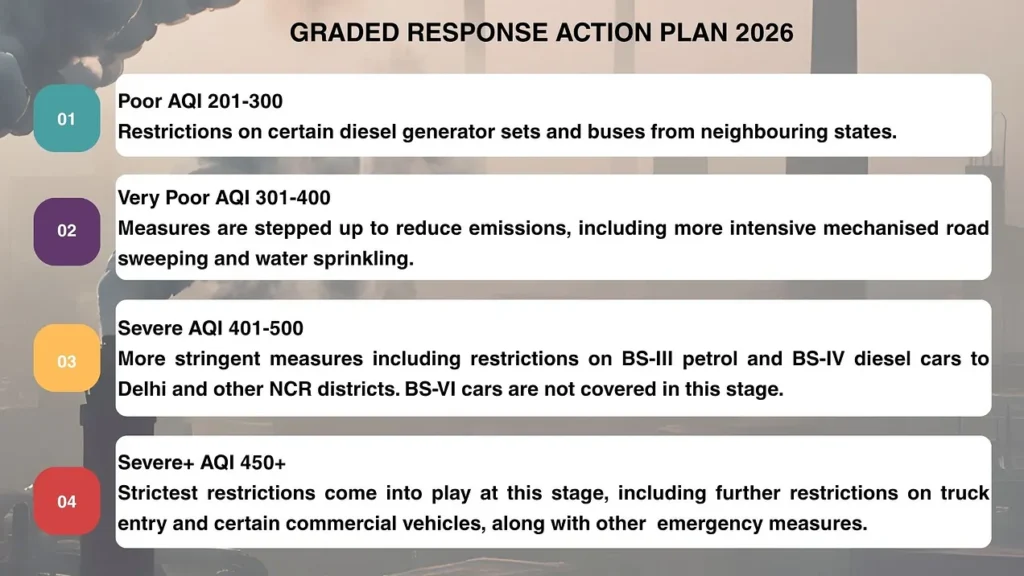
The restrictions applicable to each stage depend on the detailed GRAP schedule and the relevant orders issued by the authorities.
As of October 12, Delhi’s AQI is at 179 which is yet to reach the GRAP stage 1 criteria. For residents, the concern is not simply whether the AQI crosses a particular threshold. It is also how long pollution persists, how high concentrations rise in different neighbourhoods, and how much time people spend breathing polluted air. For someone with asthma or another respiratory condition, the effects are not confined to the days when emergency restrictions are announced.
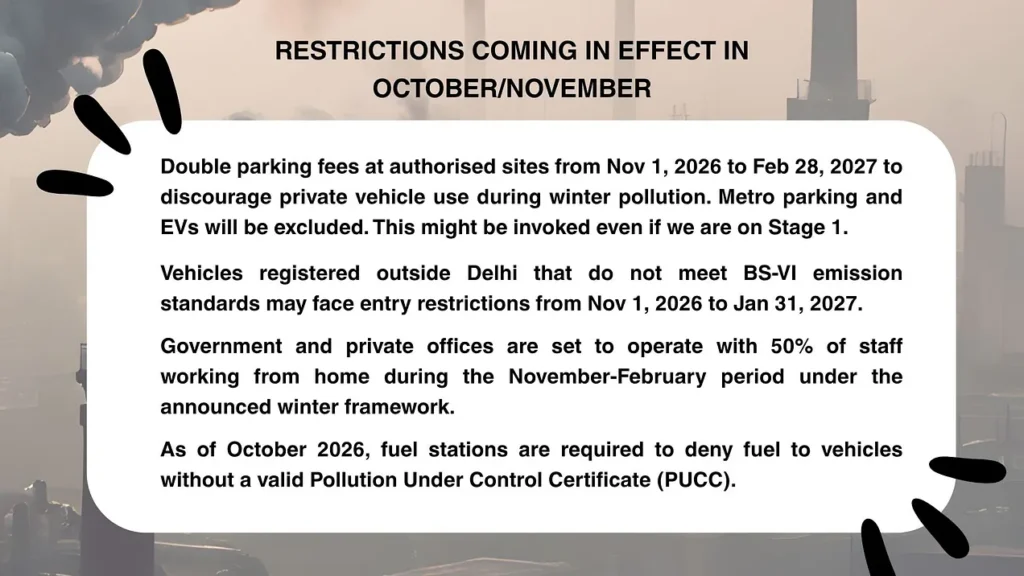
Make sure to regularly check government advisories as these regulations might change according to the GRAP Stage in effect in that moment.
The problem with being reactive
GRAP is an important emergency mechanism, but it has an inherent limitation. It responds to deteriorating air quality rather than preventing pollution from building up in the first place. By the time Stage III or Stage IV restrictions are imposed, the city is already experiencing severe or extremely severe pollution.
Additionally, having a plan is not the same as implementing it effectively, and emergency restrictions cannot substitute for reducing emissions throughout the year. According to a January 2026 news report, the Commission for Air Quality Management (CAQM) had identified significant shortcomings in the enforcement of the GRAP measures in Delhi-NCR. The institution’s inspections highlighted shortfalls ranging from 7 percent to 99.6 percent across mandated actions, including inspections at large construction sites and of mechanical road sweeping.
These are not minor lapses. Construction dust cannot be controlled on paper alone. When violations persist despite regulations, questions arise about not only the capacity of enforcement agencies, but also their willingness to act. A system in which violations can continue with little consequence risks making compliance optional for those with the means or connections to evade it. A Hindustan Times report from December 2025 reported that construction at private and semi-private projects continued unabated across the city, despite a formal ban.
What can you do?
If you spot construction activity violating pollution-control norms, excessive dust, or other violations in your locality, report them to the relevant authorities. Document the issue with photographs or videos, note the location and date, and follow up on your complaint. You can contact the following agencies to report violations:
Commission for Air Quality Management (CAQM)- 011 2370 1213
Delhi Pollution Control Committee (DPCC)- +91-11-26562122/25/33/44, 26567373, 26962819
The problem is also regional. Delhi’s air does not stop at its borders, and neither do the sources of its pollution. Vehicles, industrial emissions, construction dust, waste burning and seasonal agricultural fires all require coordinated action across the National Capital Region and beyond. No single restriction, or even a four-stage plan, can address these sources in isolation.
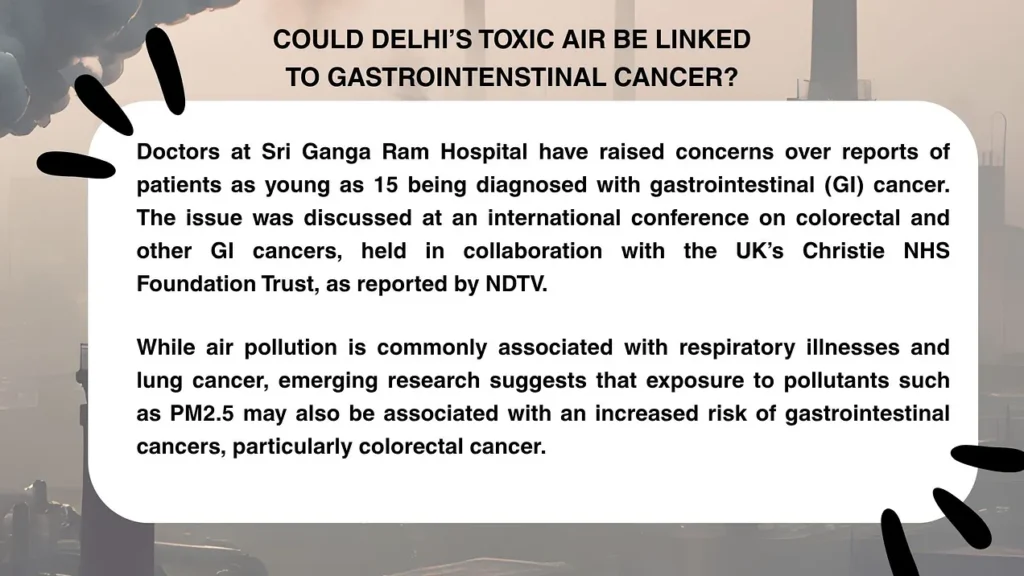
Such reports merit more research of causal link between air pollution and GI cancer in India.
The revised GRAP measures may strengthen the emergency response, but the effectiveness of these measures will depend on consistent enforcement and action throughout the year. That means monitoring construction sites before pollution peaks, reducing road dust, preventing open waste burning, improving public transport and tackling emissions at their source, rather than waiting for the AQI to climb.
I may have learnt to stay indoors during Diwali when I was 15, but years later, that still feels like an inadequate answer to a problem that returns every winter. Not everyone has the privilege to buy air purifiers, stay indoors, or leave the city during the worst of the winter months. Access to clean air should not depend on a person’s ability to protect themselves from pollution.
Delhi needs more than a plan for responding when the air becomes hazardous. It needs a commitment to making sure fewer people have to live through that hazardous air in the first place.
About the Author
Pooja Das
A writer and researcher, working in the intersection of climate change, media and storytelling.